- Visitors consistently describe this as the quieter, wilder alternative to the region’s ticketed gorges. It suits people who treat it as a short hike rather than a stroll.
- Free entry and low visitor numbers are the two things mentioned most often.
- It is less rewarding for anyone hoping to see water, because the gorge is dry for most of the year.
Local name: Pokljuška soteska

5
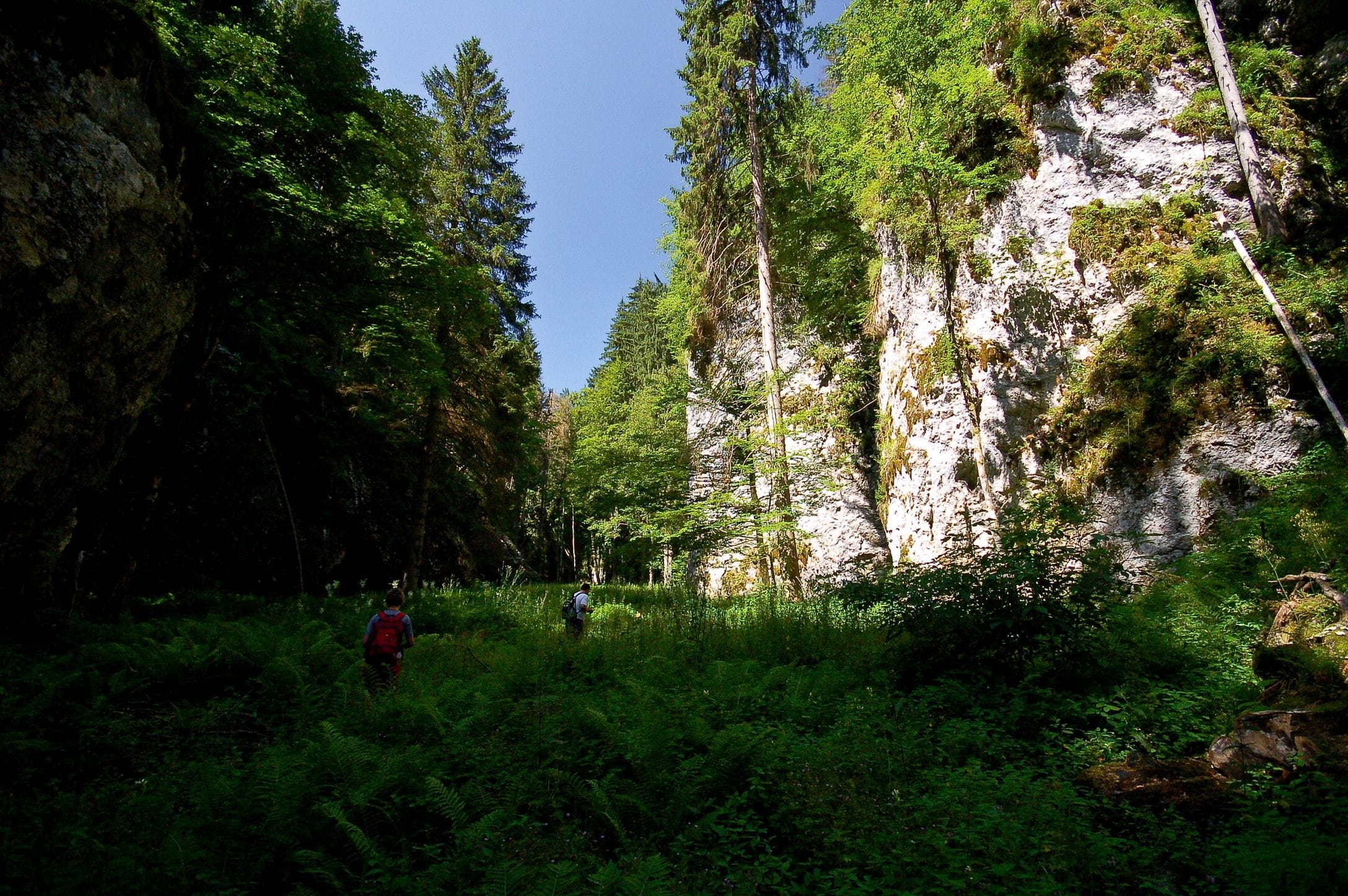
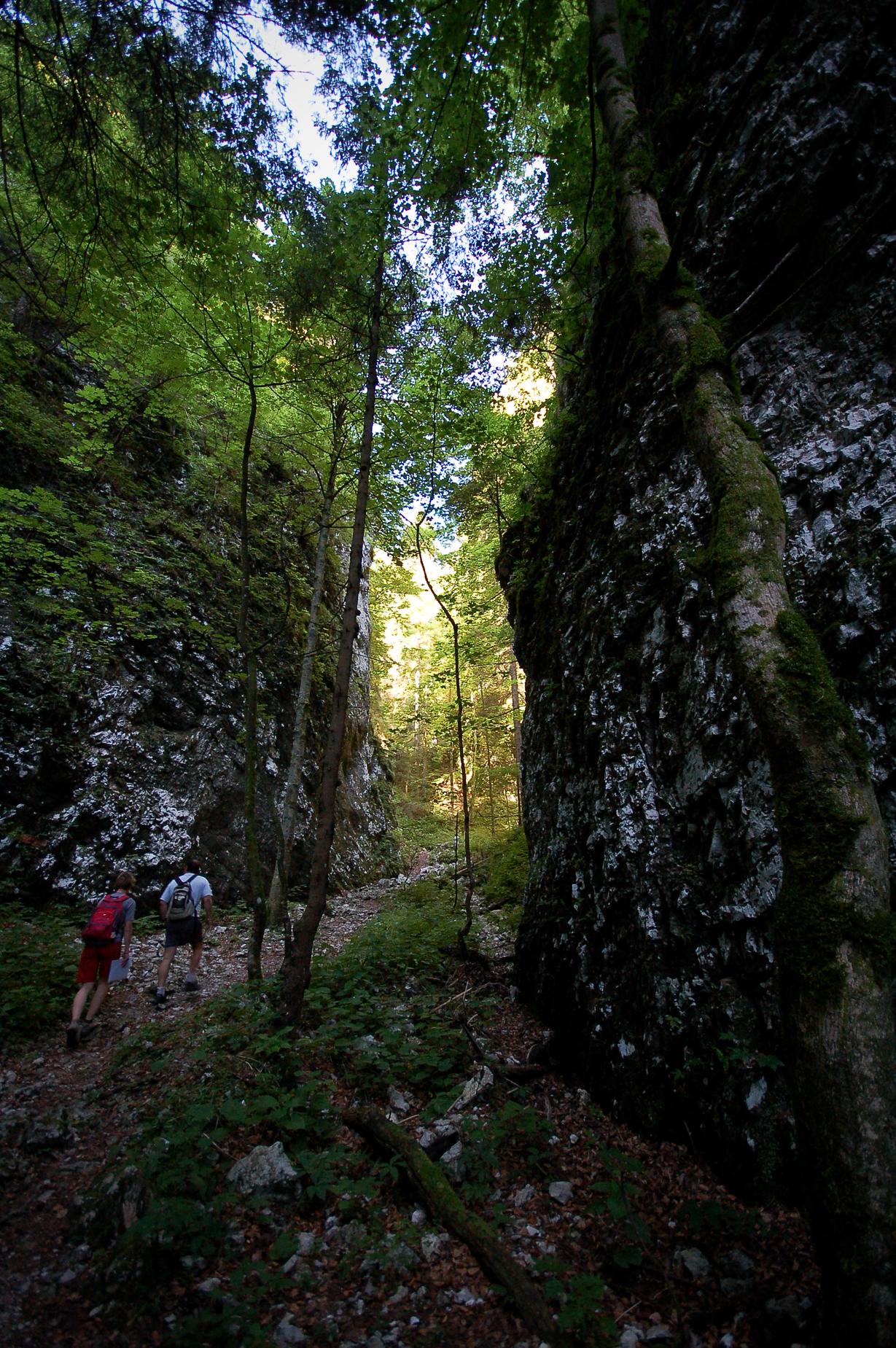


Pokljuka Gorge is the largest fossil gorge in Slovenia, and walking it means following the bed of a river that no longer runs. The limestone walls rise to around fifty metres and close, in places, to little more than a metre apart. Timber galleries fixed into the vertical rock in 1930 carry the route through the narrowest section, past a high natural rock arch and a cave you walk straight through. It sits a few kilometres from Vintgar Gorge, and it is the quieter, wilder of the two.
Plan Your Visit
<
>
Opening Hours
Open now
Open 24 hours
The gorge has no gate, ticket office or fixed opening hours and can be entered at any time. Triglav National Park recommends visiting only in the snow-free season and advises against entering in bad weather or winter conditions because of the risk of falling rock. Allow around ninety minutes for the circular route itself, and longer if you walk in from the village.
Entry Fee
Free
Free entry
Ticket prices
Official source
Entry to the gorge
Published as free of charge by Triglav National Park on both language versions of its visitor page.
Free
Official prices updated:
31 Aug 2026
- Entry to the gorge is free and there is no ticket office.
- No guided visits are currently organised here.
Parking Situation
Limited parking
View options
Parking Options
Official source
Situation: Limited parking
Parking info updated: 1 Sep 2026
- Parking at the lower entrance is not permitted.
- Park at the Gorje primary school or the Gorje cemetery car park and walk in from there; the school car park can fill up during the school year, which is when the cemetery car park is the useful backup.
- There is also a small public car park at Zatrnik, for the secondary upper approach only.
Visitor Requirements
Age guidance
View requirements Requirements
Visitor Requirements
Suitable child age groups
- Young children (4–7 years)
- Older children (8–12 years)
- Teenagers (13–17 years)
Important
- No listing-wide age, height or weight restriction is published.
- The route follows loose rock through a natural gorge, includes timber galleries fixed to a vertical wall and a short cave passage.
- Children should be closely supervised, especially on the galleries and in narrow sections.

Parking Fee
Free

Child safety note
Uneven terrain+4 more

Access Notes
Narrow road

Suitable For
Couples+4 more

Stroller accessibility
No

Wheelchair access
No

Estimated visit time
2–3 h

Family Friendly
Partly
Pet Friendly
Yes
Walking Difficulty
Moderate

Best season
Spring, Summer, Autumn
Highlights
Alpine plants below their normal altitude
High natural rock arch
Historic timber galleries in the rock face
Legend and folklore setting
River-carved limestone gorge
Cave entrance on the route
Fossil dry gorge without permanent water
Largest fossil gorge in the country
On a national geological trail
Seasonal waterfall after heavy rain
Safety Notes
!Caution after rain
!Rockfall risk — helmet recommended
!Uneven terrain
!Wear suitable footwear
Photo Tip
The strongest frames are inside the narrowest section, where the walls close to little more than a metre apart and the timber galleries give a clean line of leading perspective. Overcast light suits the gorge better than direct sun, which blows out the moss and fern detail on the floor. In the wider chambers, look up for the rock arch.
Before You Go
!Best combined with nearby attraction
!Dogs must be kept on a leash
!Free entry
!Gravel access road
!Many steps on the route
!No food service
!Not suitable for limited mobility
!Protected area
!Respect nature protection rules
!Sturdy footwear recommended
Access & Parking
Detailed access info in Plan Your Visit ↑
Parking at the lower entrance is not permitted, so drivers should park in Zgornje Gorje and walk the last stretch. Most visitors use the Gorje primary school or cemetery car park. Buses towards Pokljuka stop at Krnica, which is closer on foot. A second approach comes in from Zatrnik, where a small public car park serves the upper approach, but that route is not specially maintained and the park recommends the circular route from the lower gorge instead.
Interesting Facts
1
Slovenia’s largest fossil gorge
Pokljuka Gorge is the largest fossil gorge in Slovenia, which means the river that carved it is gone. Meltwater draining from the tongues of the Pokljuka glacier cut the channel into hard limestone roughly ten thousand years ago, then vanished as the ice retreated and the water found lower ground. The visitor path now follows that dry bed, which is why the place reads as a rock corridor rather than a waterway.
2
Walls that almost touch
The limestone walls rise to around fifty metres along the gorge, and the relief above the lower section reaches about one hundred and fifty metres. In the narrowest passages they stand only a little more than a metre apart, and several stretches genuinely overhang. A helmet is recommended because of falling-rock risk.
3
The Galleries of King Andrew
In 1930 a set of technically demanding timber galleries, thirty-five metres long, was fixed into the vertical rock of the narrowest section. They opened the shortest route between the Radovna valley and Mrzli studenec on the Pokljuka plateau. The structure was named in honour of the newborn son of King Karađorđević, who at the time held hunting rights over Mežakla, the Radovna valley and part of Pokljuka. Visitors still cross the same line today.
4
A cave you walk straight through
Pokljuška luknja is a cave hall with two entrances and three natural windows in its collapsed ceiling, and a natural ledge inside it carries the local name Prižnica, the pulpit. For centuries the passage formed the shortest footpath from Gorje up to Stara Pokljuka and on across the grazing clearings to the plateau. It is the best-known part of the gorge, and on the circular route it doubles as the return passage rather than a dead-end detour.
5
The great natural bridge
Partway along the gorge a high arch of rock spans the cleft, the Veliki naravni most, or Great Natural Bridge. It stands twenty-four metres above the floor and is three metres thick at its midpoint. It survives because the rock around it eroded faster than the arch itself, leaving a span of solid bedrock. That sets it apart from the boulder bridges found in other Slovenian gorges, which are simply large rocks wedged between two walls.
6
A waterfall that is usually not there
A side valley off the main gorge, called Stranska soteska, holds a waterfall of twenty-two metres. It appears only after sustained heavy rainfall, when torrential water briefly runs through a system that is otherwise dry. Most visitors see the empty rock chute instead, so do not plan the visit around seeing the waterfall; the park advises against entering the gorge in bad weather or winter conditions.
7
A cold pocket that pulls mountain plants downhill
Cold air pools on the shaded gorge floor and moisture lingers, producing a microclimate several degrees below the surrounding forest and drawing mountain species well beneath the elevations where they normally live. Surveys of the gorge have recorded 262 vascular-plant taxa, 14 of them protected, along with the subendemic Burser’s saxifrage. Auricula, Scheuchzer’s bellflower and the ostrich fern that thrives in the damp lower section are among the plants singled out here.
8
Two hundred million years written into the walls
The grey limestone of the gorge carries dark nodules of chert, sometimes visibly bulging from the rock face. Both the limestone and the chert formed from sediment laid down on a deep sea floor a little over two hundred million years ago, long before the Julian Alps existed as mountains. The exposure is good enough that the Slovenian Geological Trail routes through the gorge, using the walls as a readable cross-section of that history.
9
The vrtci, and the charcoal burners’ clearing
Between its narrow passages the gorge repeatedly opens into wider, flatter chambers that local people call vrtci, literally nurseries. Three are prominent enough to be named: the Climbing vrtec, the Central vrtec and the Last vrtec. Beyond the Last vrtec the path crosses a kopišče, a levelled patch of ground where charcoal was once burned in earth-covered stacks. Above the cave lie rovti, cleared meadows such as Janezov rovt and Pustovo polje, still grazed each summer.
10
Protected as a natural monument since 1993
The gorge has been a protected natural monument since a 1993 ordinance and is treated as a natural monument of national importance. It sits inside Triglav National Park, which forms the core of the UNESCO Julian Alps Biosphere Reserve. Within the monument area the forest is deliberately left to natural processes rather than managed, so the fallen trunks and standing deadwood along the route are part of the protection rather than neglect.
11
The month the dry river came back
In August 2023 the usually dry channel reactivated as a torrent during extreme rainfall, destroying substantial sections of the visitor path and closing the gorge. Major repairs followed through 2024, including work by a visiting trail crew from Crater Lake National Park in the United States, a park twinned with Triglav. The episode is a clear reminder that a fossil gorge is still an active landscape, and the park advises against visiting in bad weather or winter conditions.
12
A reformer’s hiding place, by tradition
Local tradition holds that Primož Trubar, the sixteenth-century Protestant reformer who produced the first printed books in Slovene, sheltered in Pokljuška luknja while fleeing towards Germany. It is carried as a legend rather than as documented biography, and nothing places him there beyond the story itself. It gives the cave a second layer of interest for anyone who already knows Trubar’s name.
Visitor Wisdom
Traveler Insights
Combined public visitor ratings from Google and Tripadvisor. Last verified August 2026.
- The most repeated theme is solitude, and many visitors report meeting only a handful of people on the whole route.
- The galleries draw the strongest reactions and are described as the moment the walk turns into an adventure.
- People also single out the scale of the overhanging walls and the depth of green on the gorge floor. Several describe stepping out of the narrow section into a wider chamber as walking into a lost world.
- Parking at the lower entrance is not permitted, so drivers should use the Gorje primary school or cemetery car park and walk in; the school car park can fill up during the school year.
- Signage inside the lower gorge is good, but the upper circular return is where people most often lose the route and turn back.
- Footwear matters more than expected, because the floor is loose rock and roots throughout.
- A helmet is recommended because of falling rock, and there is a visitor toilet at the lower entrance.
- It suits confident walkers, photographers, families with children who are used to walking, and anyone actively trying to avoid crowds.
- It is a poor choice for pushchairs, wheelchair users and visitors with limited mobility, and older visitors have reported turning back at the first rocky section.
- Anyone who would rather have a surfaced path and a view can pair a short look at the lower gorge with an afternoon at Bled Castle , a short drive away.
- Arriving in trainers is the mistake visitors regret most, because the floor is loose rock rather than a made path.
- The park advises against visiting in bad weather or winter conditions, when the terrain can be slippery and wet.
- Driving all the way to the lower entrance expecting to park is another: visitor parking there is not permitted, so use the village car parks and walk in.
- Others start the circular route late in the day and run out of daylight in the forest section above the gorge.
- Going up the gorge floor first and returning over the rim through the cave keeps the best section ahead of you rather than behind you.
- Early morning gives the most even light in the narrow part and the best chance of having it to yourself.
- Inside the cave, look for the natural ledge the locals call Prižnica, the pulpit.
- In the wider chambers, look up for the rock arch, which is easy to walk straight under without noticing.
- Families report that the cave and the galleries are the parts children remember, and the wider chambers make natural places to stop and rest.
- Family walking guides put the route within reach of children of around three or four who are already used to walking.
- Pushchairs are not usable anywhere on the route.
- Expect to hold hands on the timber sections and through the narrowest passage, where the footing is uneven and the drop beside the walkway is real.
- Photographers consistently rate the passage where the walls close in as the strongest subject, with the timber galleries adding structure and scale against the rock.
- Overcast conditions are widely preferred, because direct sun creates harsh contrast between the lit rim and the shaded floor.
- The ferns and moss reward close work as much as wide frames.
- Light inside the cave is low, but the openings in the collapsed ceiling throw usable shafts on bright days.
- The lasting impression visitors describe is surprise: a landscape this dramatic, this close to one of Slovenia’s busiest resorts, and almost empty.
- It is not a polished attraction and visitors do not generally describe it as easy, but that is precisely what many say they valued.
- Those who arrive expecting a scenic river walk are more likely to be disappointed, while those who arrive expecting a short adventure tend to leave satisfied.
Quick Facts
Estimated visit time
2–3 h
Best season
Spring, Summer, Autumn
Walking difficulty
Moderate
Family friendly
Partly
Pet friendly
Yes

Entry Fee
Free

Access type
Uneven rocky path
Help Improve This Listing
Found outdated information, a mistake, or a useful local tip? Let us know.
Suggest an Update →Help Improve This Listing
Your feedback helps us keep Explore In Slovenia accurate and useful for future visitors.
×Visitor Reviews
Write a review
No visitor reviews yet.
Be the first to share your experience.
No reviews yet!
Sorry! Please login first to submit reviews.