- Strongly recommended if you have a real interest in archaeology, prehistory or the origins of music. The appeal lies in what was found here rather than in what you see: there are no formations or show-cave lighting, but you stand inside a real excavation site with its sediment layers still visible.
- The two-hour guided format, fixed departures and steep descent mean the visit rewards planning rather than improvisation.
Local name: Arheološki park Divje babe

8

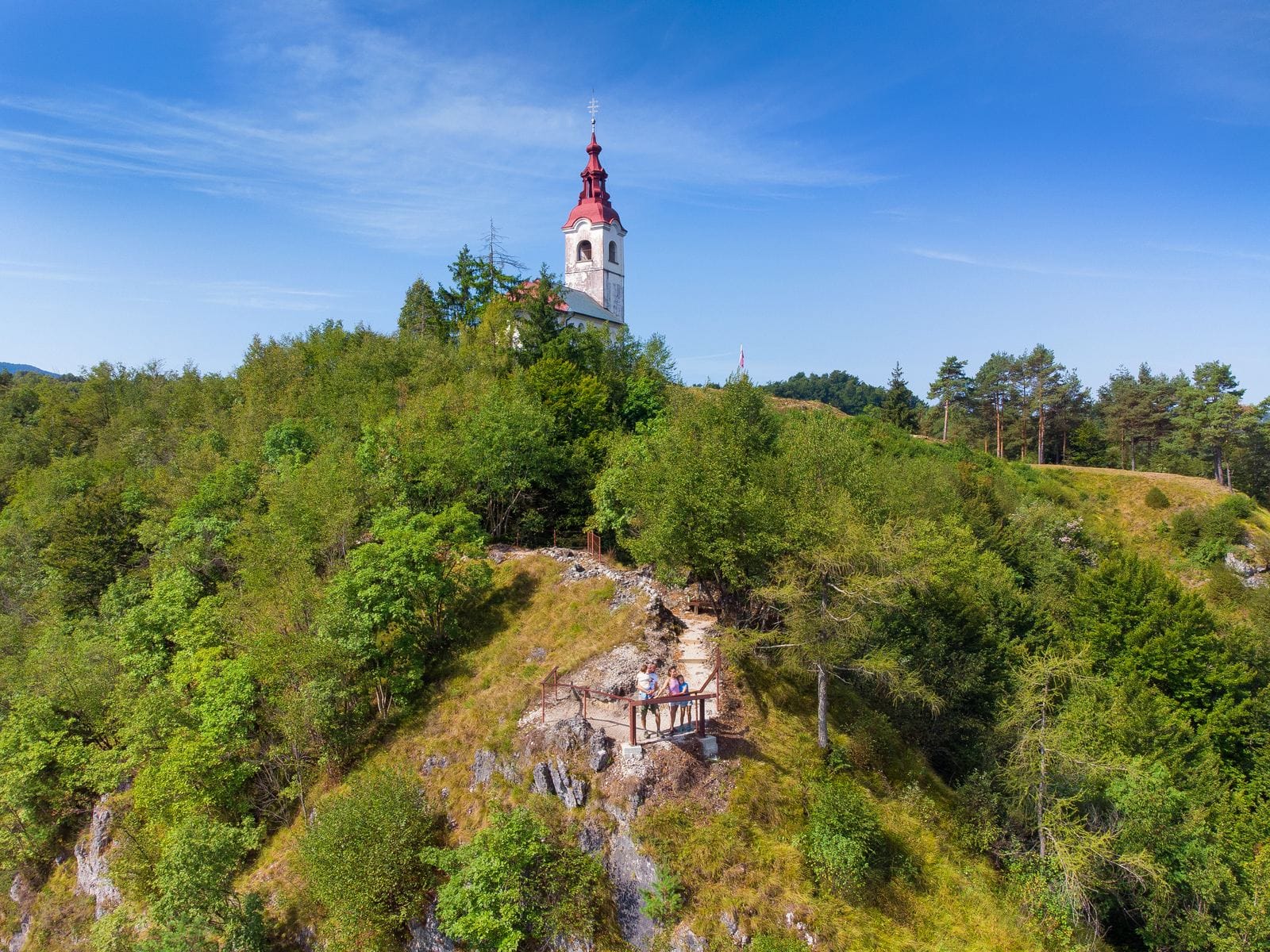
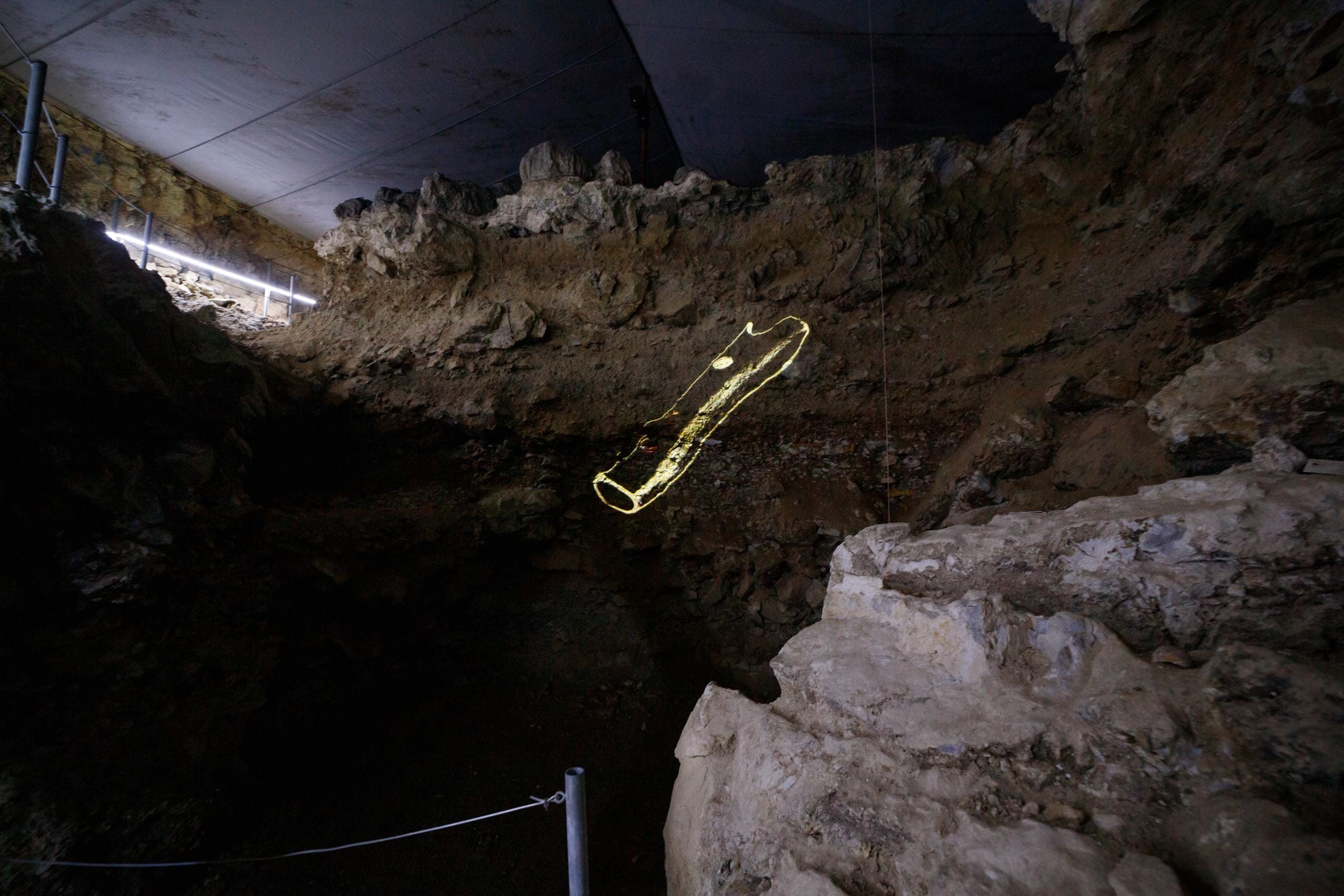
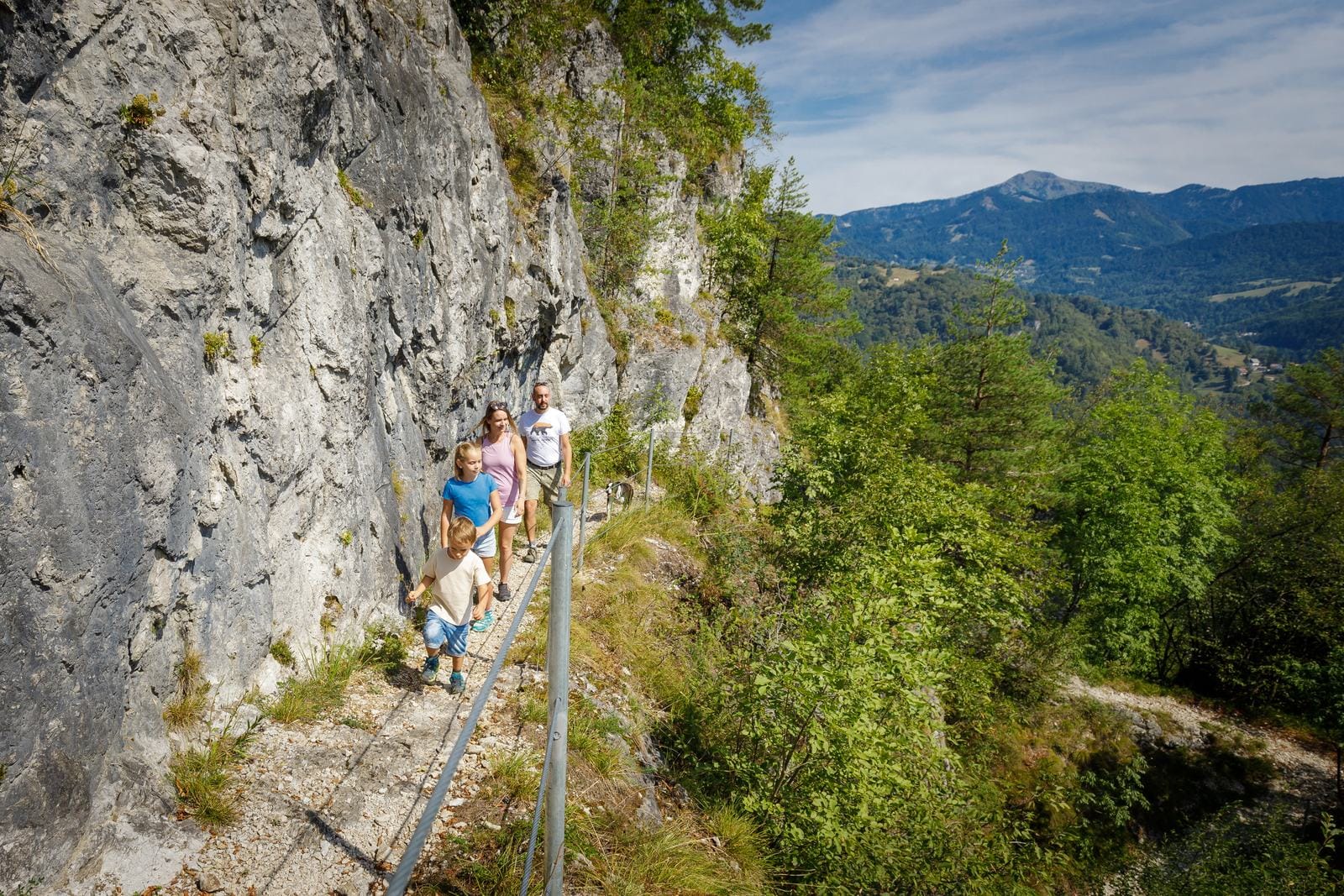
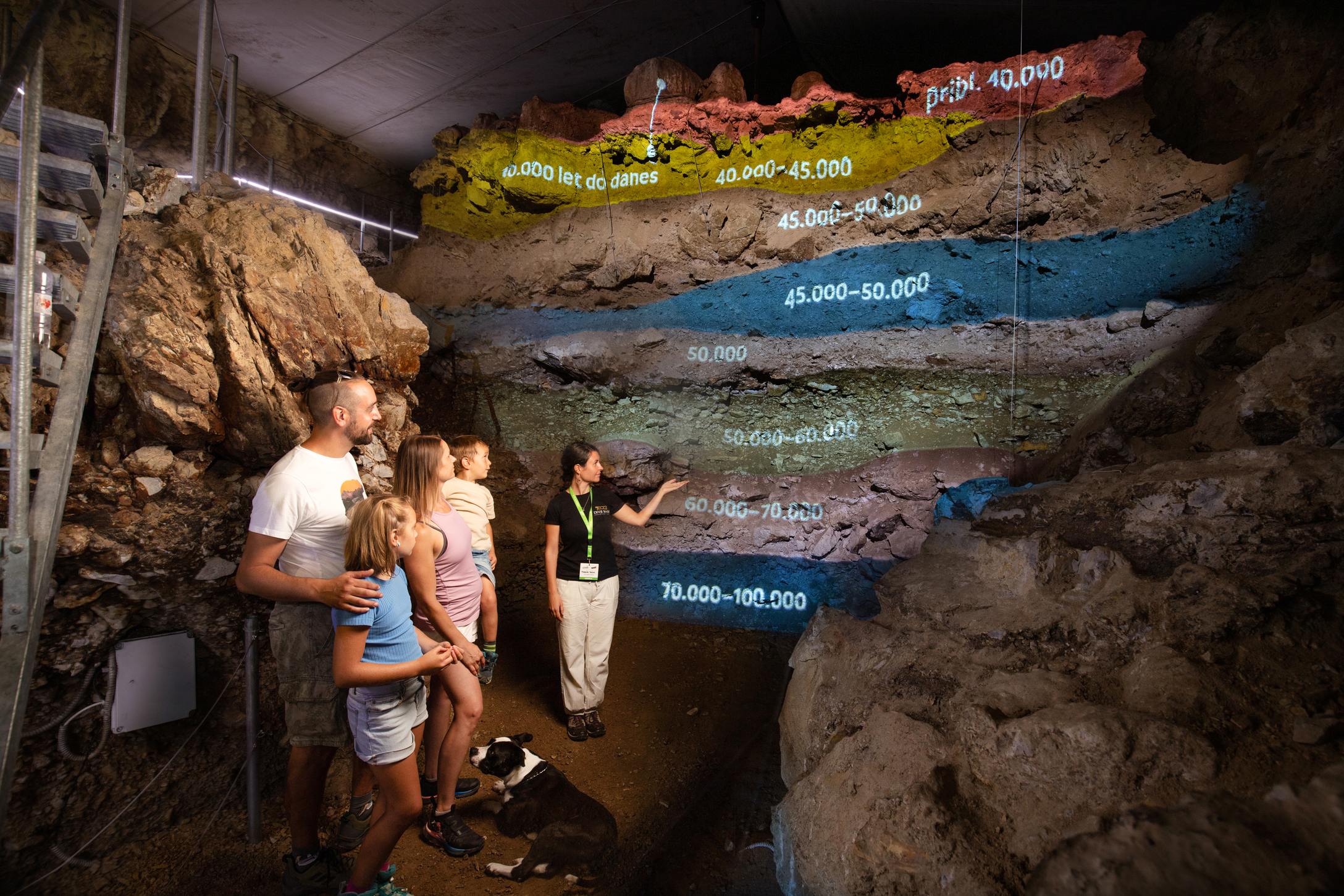
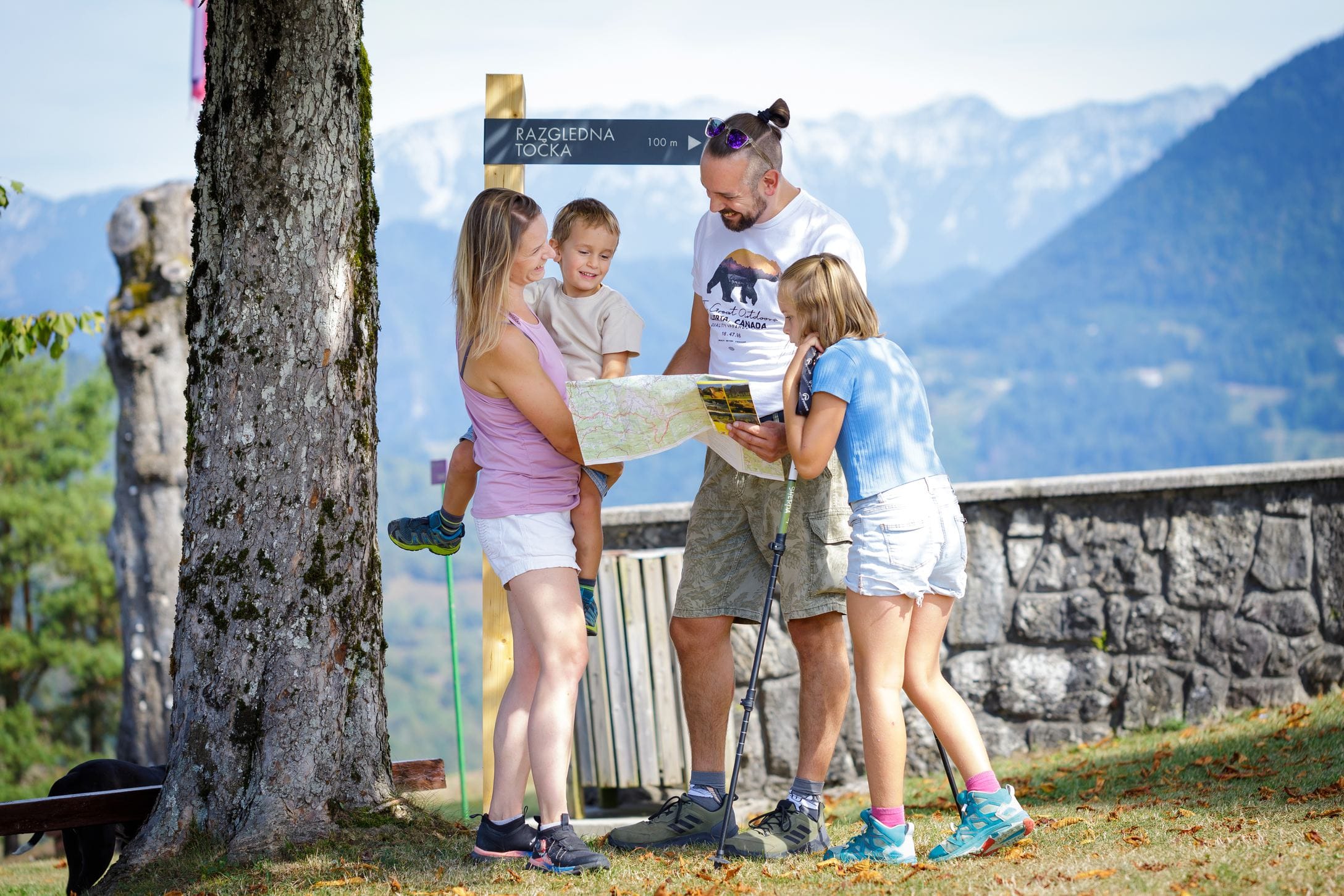
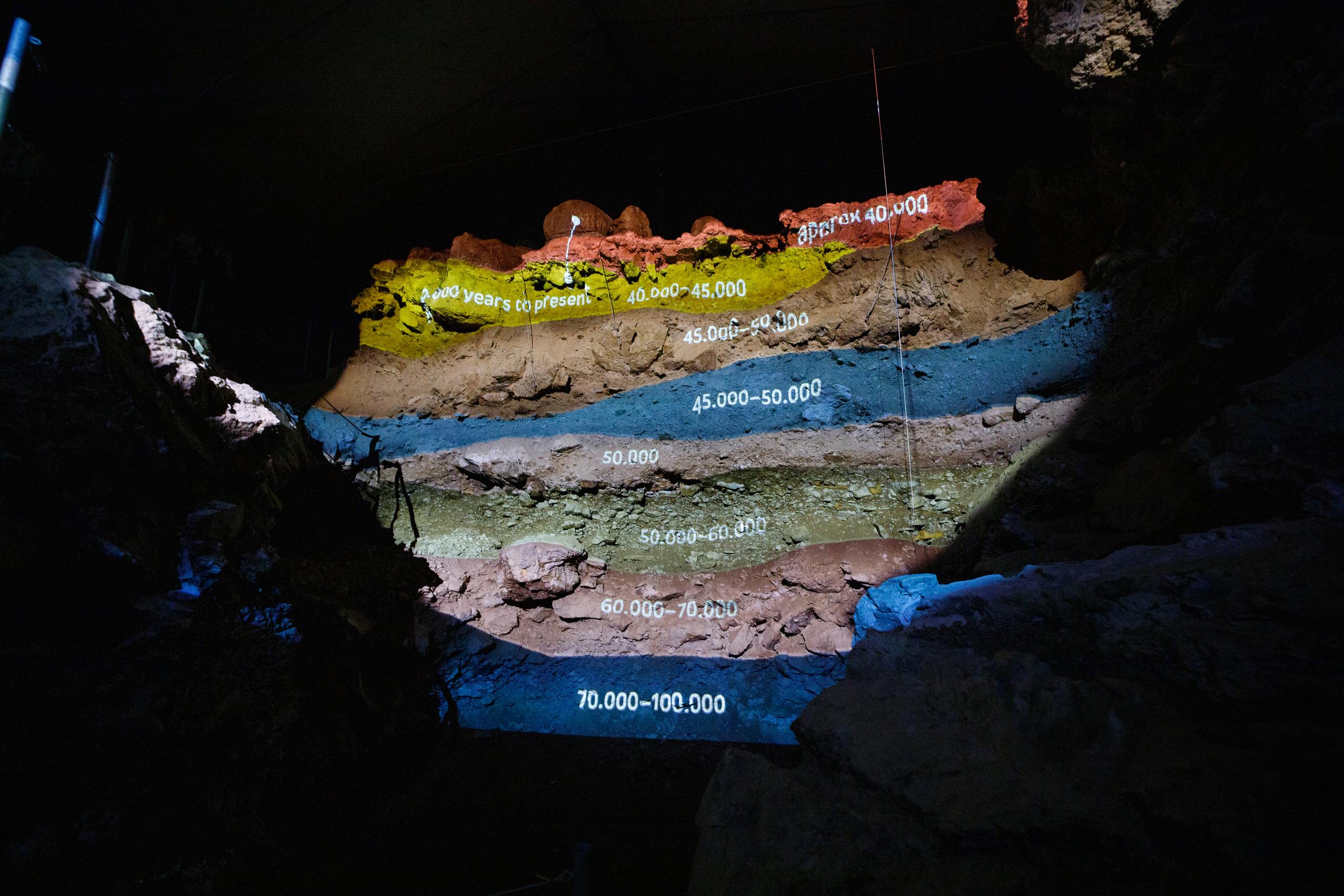
High on the edge of the Šebrelje Plateau, above the Idrijca valley, is the cave where a perforated cave bear bone known as the Neanderthal flute was found in 1995. A guide leads you down a steep path to the cave, and inside, projections show the Neanderthal world and let you hear a reconstruction of the instrument in the chamber where the bone lay. The tour ends on the plateau, at a viewpoint over the valley. Pair it with the Idrija Mercury Mine for a day of two very different underground visits.
Plan Your Visit
<
>
Opening Hours
Hours available
Today: Check official source
Guided tours are the only way into the cave, which is locked at all other times. Public tours run from 15 April to 15 October and need no advance registration. Tours outside the public schedule must be booked at least three working days in advance. Extra public tours are sometimes announced for state holidays that fall on a day without a regular departure. The park exterior and marked trails can be explored independently all year.
View opening hours
Mid-April — Saturday tours (Apr 15–Apr 30)–
May — weekend tours (May 1–May 31)–
Summer — Thursday afternoon tour (Jun 1–Aug 31)–
Summer — weekend morning tours (Jun 1–Aug 31)–
September — weekend tours (Sep 1–Sep 30)–
Early October — Saturday tours (Oct 1–Oct 15)–
Closed season — no public guided tours (Oct 16–Apr 14)Closed
Entry Fee
Paid
Adults EUR 12.00
Ticket prices
Official source
Guided Tour — Standard Rates
The two-hour guided cave tour for individual visitors and groups of 6–20 people. It includes the cave, the walk, the World War I remains and the valley viewpoint. Announced public tours need no advance registration; tours outside the public schedule must be booked at least three working days ahead.
Includes
- Guided tour of Divje Babe Archaeological Park
- Entry to the digitally enhanced Divje babe I cave
Guided tour season (15 April – 15 October)
Adult
€12.00
Children 6–15 years
€9.00
Children up to 5 years
Free
Guided Tour — Small Group (up to 5 People)
A private guided cave tour for up to five people at one flat group price. Book at least three working days ahead.
Includes
- Guided tour of Divje Babe Archaeological Park
- Entry to the digitally enhanced Divje babe I cave
Guided tour season (15 April – 15 October)
Small group, up to 5 people
Total price for the group, not per person.
€70.00
Guided Tour — Groups of More Than 20 People
Reduced per-person guided cave tour rates for organised groups of more than 20 people.
Includes
- Guided tour of Divje Babe Archaeological Park
- Entry to the digitally enhanced Divje babe I cave
Guided tour season (15 April – 15 October)
Adult
€10.00
Children 6–15 years
€7.00
Guided Tour — School Groups
Guided cave tour for school groups, with the programme adapted to the age of participants.
Includes
- Guided tour of Divje Babe Archaeological Park
- Entry to the digitally enhanced Divje babe I cave
Guided tour season (15 April – 15 October)
Pupils and students
€7.00
Guided VR Experience — Eligible Visitors
A guided VR alternative without physical cave entry, available by prior arrangement to visitors with limited mobility and to school groups outside the regular tour season. School groups use CŠOD Cerkno; for limited-mobility visitors it can be arranged near the Church of St. Ivan. It is not a general standalone booking for individual visitors.
By prior arrangement
Eligible VR visitors
€5.00
Official prices updated:
1 Oct 2026
- Individual visits are paid in cash; cards are not accepted.
- Organised groups may also pay by official purchase order.
Parking Situation
Small parking
View options
Parking Options
Official source
Situation: Small parking
Parking info updated: 1 Oct 2026
- The free parking near the Church of St. Ivan is for passenger cars only and has space for around 10 cars or more, about five minutes’ walk from the meeting point.
- The free trailhead parking at Reka, in the valley below the plateau, takes up to about five vehicles depending on vehicle type and is accessible to motorhomes and buses.
Visitor Requirements
Age guidance
View requirements Requirements
Visitor Requirements
Suitable child age groups
- Older children (8–12 years)
- Teenagers (13–17 years)
Important
- Ticket ages: Children up to 5 years enter free; the child ticket covers ages 6–15.
- Supervision: Visitors under 14 must be accompanied by a parent, guardian or other adult.
- Route: The cave approach takes 15–20 minutes each way over steep, uneven ground with stone steps and about 120 metres of elevation change; younger children may need to be carried.
- School groups: The programme is adapted to the age of the participants.

Parking Fee
Free

Child safety note
Uneven terrain+3 more

Access Notes
Arrive 15 minutes early

Suitable For
Couples+5 more

Stroller accessibility
No

Wheelchair access
No

Estimated visit time
2–3 h

Family Friendly
Partly

Pet Friendly
Yes
Walking Difficulty
Moderate

Best season
Spring, Summer, Autumn
Highlights
Cave bear bone site
Digitally enhanced on-site interpretation
Palaeolithic archaeological site
Prehistoric music heritage
Cultural monument of national importance
Excavation layers visible in situ
Panoramic plateau setting
Replica of a world-significant find on site
Safety Notes
!Stay on marked paths
!Steep path
!Uneven terrain
!Wear suitable footwear
Photo Tip
The best photos here are taken above ground: the isolated Church of St. Ivan on the edge of the plateau, and the wide view over the Idrijca valley from the viewpoint where the tour ends. Late afternoon light works especially well across the ridges. Photography and filming inside the cave are generally not permitted.
Before You Go
!Cash payment only
!Dogs must be kept on a leash
!Fixed tour departure times
!Guided tour only
!Not suitable for limited mobility
!Photography restrictions may apply
!Seasonal access
!Sturdy footwear recommended
!Ticket required
!Underground visit
Access & Parking
Detailed access info in Plan Your Visit ↑
Most visitors drive up the narrow, winding road onto the plateau and park for free near the Church of St. Ivan, a short walk from the meeting point. That parking is for passenger cars only; motorhomes should use the free trailhead parking at Reka, in the valley below, where the marked Mulatjera Trail climbs to the plateau. Group coaches drop passengers at a separate designated turning point. Arrive early, because tours leave at fixed times.
Interesting Facts
1
The bone that changed the argument
In 1995, archaeologists Ivan Turk and Janez Dirjec of the ZRC SAZU Institute of Archaeology lifted a perforated cave bear femur from a Mousterian layer of Divje babe I. The bone lay close to the remains of a hearth dated to between 50,000 and 60,000 years ago. Because of where it lay, researchers concluded that if the object was shaped by human hands, only Neanderthals could have made it.
2
Why the flute is still debated
The interpretation of the perforated femur remains contested. Slovenian researchers, supported by experimental piercing tests and synchrotron micro-computed tomography, argue that the aligned holes could not have been produced by carnivore teeth. Critics including Francesco d’Errico, Iain Morley and Cajus Diedrich have maintained that hyenas or other carnivores gnawed the bone instead. Slovenia’s national institutions present the object as a musical instrument, while much of the international research community still treats it as an open question.
3
Layers spanning eighty thousand years
Excavation at Divje babe I has documented archaeological layers between roughly 35,000 and 116,000 years old, from the Middle Palaeolithic Mousterian to the beginning of the Upper Palaeolithic Aurignacian. The youngest levels studied belong to the period when the last Neanderthals and the first anatomically modern humans overlapped in Europe. Researchers have identified successive occupation layers with hearths and stone and bone tools, and metres of preserved cave sediment remain for future research.
4
Slovenia’s first digitally enhanced cave
Divje babe I is presented as Slovenia’s first digitally enhanced cave. During guided tours, projections on the cave walls reconstruct the archaeological layers in the lower part of the cave and the world of the Neanderthals in the upper part. One sequence lets visitors hear a reconstruction of the instrument in the chamber where the original bone was found. Outside tour times the cave is locked, so the experience exists only with a guide present.
5
Protected at the highest national level
In December 2025 the Government of Slovenia declared Divje Babe Archaeological Park a cultural monument of national importance by decree, replacing earlier local protection in the year of the discovery’s thirtieth anniversary. The designation covers the Divje babe I and Divje babe II caves, an open-air Palaeolithic site on the plateau and the surrounding landscape. The decree also treats the remaining sediments as a scientific reserve.
6
The original is not on site
Visitors who come expecting to see the flute itself will not find it here. The original perforated femur is held by the National Museum of Slovenia in Ljubljana, where it is one of the collection’s best-known objects. What you visit here is the place where it was found: the cave, its sediment layers and the plateau landscape around it, together with a replica you can handle.
7
Tidldibab and the musicians who play it
Reconstructions of the instrument have been played publicly for three decades. Musicologist Drago Kunej was among the first to test its acoustic properties, and the academic musician Ljuben Dimkaroski developed a playing technique on a working replica, naming his instrument Tidldibab after Ivan Turk, himself and the cave. The multi-instrumentalist Boštjan Gombač has continued this work and has performed on a reconstruction at the site itself.
8
More than sixty animal species in the sediment
Beyond the famous find, the cave sediments have produced remains of more than sixty animal species, dominated by the cave bear. Together with charcoal, pollen and small-mammal remains, they form one of the fullest Pleistocene environmental records in Slovenia. Some of the species identified are extinct; others simply withdrew from this landscape as the climate shifted. Bone layers remain visible in the cave sediments during the guided visit.
9
More than prehistory on the plateau
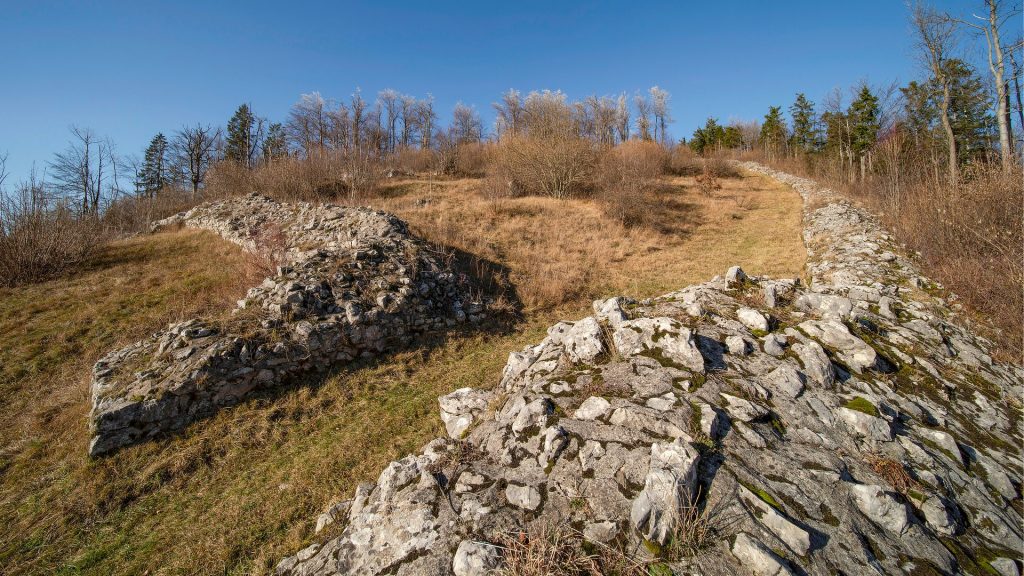
The guided route begins in front of the Church of St. Ivan and also passes traces of much later history. The trenches and caverns near the church were dug by Bosniak units of the Austro-Hungarian army during the First World War, as part of the rear defensive line behind the Isonzo Front. Together with the viewpoint over the Idrijca valley, they make the plateau itself part of the visit, not just the approach to the cave.
10
Wild women in the cliff
The name Divje babe translates roughly as wild women. Local tradition held that mysterious female figures lived in the caves below the plateau, and parents used the story to keep children away from the drop. Village accounts say the warning did not always work: children explored the lower cave by torchlight and carried bones back to the parish priest, who realised something unusual lay inside. Systematic excavation began in 1980 and continued until 1999.
Visitor Wisdom
Traveler Insights
Combined public visitor ratings from Google and Tripadvisor. Last verified August 2026.
- Guides are singled out again and again: knowledgeable, unhurried and able to make the archaeology vivid rather than technical.
- The projections inside the cave work well, especially hearing a reconstruction of the instrument in the chamber where the bone was found.
- The plateau itself, with its isolated church, wide views over the Idrija–Cerkno hills and a real sense of quiet.
- Visiting a site of world scientific significance with almost nobody else there.
- The original flute is not here — it is displayed at the National Museum of Slovenia in Ljubljana, while the park holds a replica visitors can handle.
- The cave is locked and the projections switched off outside guided tours, so arriving independently means seeing the outside only.
- Payment is cash, taken on the day by the guide. Cards are not accepted anywhere on site.
- Motorhomes should use the Reka/Mulatjera trailhead parking; the church parking is for passenger cars only.
- Photography and filming inside the cave are generally not permitted because it is a protected archaeological site.
- The descent is around 120 metres of elevation over steep, uneven ground, and the climb back up is the harder half.
- Best for: archaeology and history enthusiasts; families with school-age children; landscape photographers; independent visitors exploring the Idrija–Cerkno hills; anyone curious whether Neanderthals made music.
- Less ideal for: visitors with limited mobility on the physical cave route, although a guided VR alternative can be arranged in advance for eligible visitors; families with toddlers or babies; anyone hoping for stalactites, lighting and paved walkways, since this is an archaeological site, not a show cave.
- Making the trip without checking the tour schedule. Outside June to August there may be only one or two regular departures a week.
- Arriving without cash. There is no card payment anywhere on site.
- Wearing smooth-soled shoes. The path is steep, uneven and slippery after rain.
- Setting off from Reka on foot without allowing a full hour for the climb, then missing the departure.
- Expecting to photograph inside the cave. Photography and filming there are generally not permitted.
- Expecting to see the original flute. It is kept in Ljubljana; here you see the place where it was found and can handle a replica.
- Leave time after the tour for the Church of St. Ivan, the nearby World War I remains and the viewpoint over the Idrijca valley.
- The World War I trenches and caverns near the church are easy to walk past, so look for them as you explore the plateau.
- Coming up the Mulatjera Trail from Reka turns a two-hour visit into a half-day and gives the clearest sense of how the plateau sits above the valley.
- Šebreljski želodec, the protected cured meat named after this plateau, is worth seeking out locally.
- Children from roughly eight upward tend to engage well; cave bears, bone tools and the story of a possible Neanderthal flute are strong hooks.
- The projections carry much of the storytelling, which helps hold attention across two hours.
- The descent is the limiting factor: steep, uneven and stepped in places. Younger children may need carrying both ways.
- Visitors under 14 must be accompanied by a parent, guardian or other adult.
- Children up to five go free, and school groups get a programme adapted to the age of participants.
- The isolated church on the plateau edge is the signature image, strongest in late afternoon light.
- The viewpoint that closes the tour gives the widest composition over the Idrijca valley and the Idrija–Cerkno hills.
- Photography and filming inside the cave are generally not permitted because it is a protected archaeological site, so plan the strongest photo work outside.
- The drive across the plateau has several informal pull-in points with long views.
- Visitors tend to leave more affected than they expected. The remote plateau, a guide who knows the material and a cave where something of real importance was found make the visit feel weightier than its scale suggests.
- There is little spectacle; what stays with people is standing in a quiet place where the question of what Neanderthals were capable of was reopened.
Quick Facts
Estimated visit time
2–3 h
Best season
Spring, Summer, Autumn
Walking difficulty
Moderate
Family friendly
Partly
Pet friendly
Yes

Entry Fee
Paid

Access type
Steep path
Help Improve This Listing
Found outdated information, a mistake, or a useful local tip? Let us know.
Suggest an Update →Help Improve This Listing
Your feedback helps us keep Explore In Slovenia accurate and useful for future visitors.
×Visitor Reviews
Write a review
No visitor reviews yet.
Be the first to share your experience.
No reviews yet!
Sorry! Please login first to submit reviews.