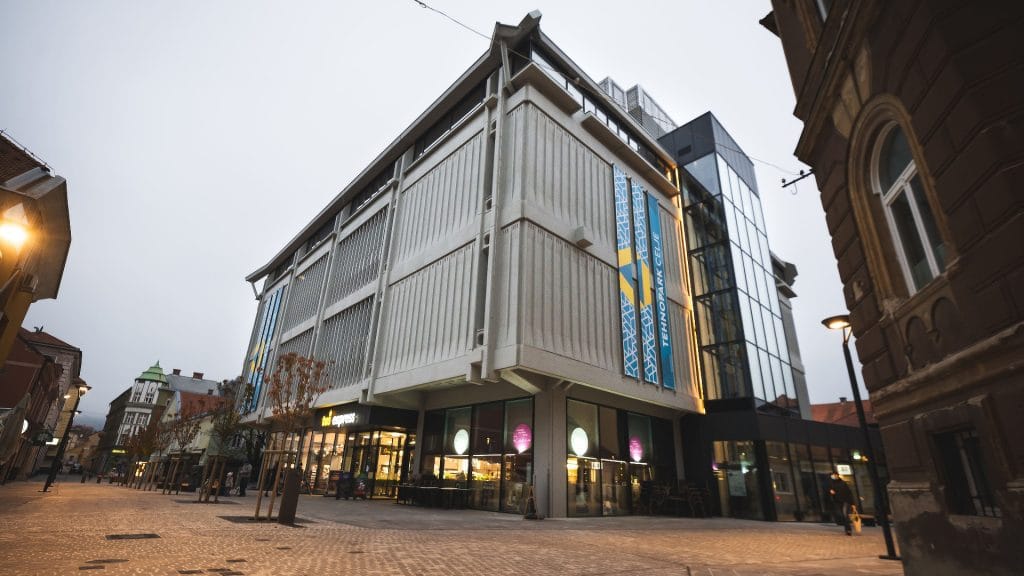
Visitors consistently describe it as far better than the modest exterior suggests. The strongest praise goes to the guiding and to how well the technology carries the geology. Adults regularly report enjoying it as much as the children they brought. It is a short, self-contained visit rather than a half-day destination. Most people fold it into a wider day around Grad and Goričko.
Local name: Doživljajski park Vulkanija
1
At Vulkanija you walk through a recreated lava tube, ride a lift that simulates a drop into a magma chamber and finish with a bumpy 3D train sequence back to the surface. The guided route takes about an hour, and it runs on the crater of the last volcano to erupt in Slovenia, three million years ago. Next door, a geological museum in an old tannery holds the minerals and the fossils, and the same ticket can be extended to Grad Castle on the hill above.
Plan Your Visit
<
>
Opening Hours
Closed now
Opens in 9h 40m
Today: 10:00–18:00
April–October
Closed every Monday. Guided visits start every full hour. Allow 1.5 hours: the guided tour lasts one hour and the geological museum is self-guided. Tours also run in German and English, and a foreign-language tour must be booked in advance.
Tue 10:00
April–October10:00–18:00
November–December10:00–16:00
January–March10:00–16:00
New Year’s Day (Jan 1)Closed
2 January (Jan 2)Closed
Easter Sunday (movable date · calculated annually)Closed
1 November (Nov 1)Closed
Christmas Day (Dec 25)Closed
26 December (Dec 26)Closed
Entry Fee
Paid
Adults EUR 12.00
Ticket prices
Official source
Vulkanija Adventure Park
Admission to the guided volcano route at Vulkanija and to the geological museum in the Lednar tannery. The nearby basalt tuff quarry is free to visit independently and is not an included paid ticket component.
Includes
- Vulkanija Adventure Park
- Geological Museum in the Lednar Tannery
Standard prices
Adults
€12.00
Secondary-school and university students
The official price list groups students and pensioners in one category at the same price.
€10.00
Pensioners
The official price list groups students and pensioners in one category at the same price.
€10.00
Children aged 6–15
€9.00
Children up to 5 years
Free when accompanied by two adults.
Free
Family ticket
2 adults + 2 children up to 15 years.
€33.00
Kindergarten children in organised groups
Per child in an organised kindergarten group.
€5.00
Wheelchair users, deaf or hard of hearing, blind or partially sighted visitors
€8.00
Companions of visitors with disabilities
Companions pay the full adult rate.
€12.00
Optional experiences
Oli Road Train — Through the Volcanic Landscape
A 45-minute road-train ride from the Vulkanija visitor parking area to the basalt tuff quarry and back along a panoramic route above the crater. At the quarry a guide explains the volcanic rock and two short films cover quarry work and olivine. The quarry itself is independently accessible free of charge 24/7; this paid add-on is for the train ride and guided quarry programme. Runs from mid-March to mid-November in suitable weather. Capacity 54; the final carriage is adapted for wheelchair users. For individual visitors it runs during the May Day, summer and autumn school holidays and at park events; groups book it by arrangement.
Adults
The official price list groups adults, students and pensioners at one price.
€4.00
Students
The official price list groups adults, students and pensioners at one price.
€4.00
Pensioners
The official price list groups adults, students and pensioners at one price.
€4.00
Children up to 15 years
€3.00
Wheelchair users (children and adults)
€3.00
Whole-train hire including driver
Per started hour, timed from departure from the car park until the train returns to it.
€70.00
Combined Ticket — Vulkanija + Grad Castle
One ticket covering Vulkanija and the geological museum plus admission to Grad Castle, the largest castle complex in Slovenia.
Includes
- Vulkanija Adventure Park
- Grad Castle (grad Grad)
Standard prices
Adults
€16.00
Pensioners
The combined-ticket list prices pensioners separately from students.
€13.00
Secondary-school and university students up to 26 years
The combined-ticket list prices students separately from pensioners.
€12.00
Children aged 6–15
€11.00
Children up to 5 years
Free when accompanied by two adults.
Free
Family ticket
2 adults + 2 children up to 15 years.
€44.00
Official prices updated:
24 Aug 2026
- One ticket covers the guided park and the geological museum.
- The basalt tuff quarry about a kilometer away is free to visit independently at any time; visitors enter at their own responsibility and should follow the rules posted at the entrance.
- The Oli road train is a separate seasonal extra that adds a guided stop at the quarry and two short films.
- A combined ticket with Grad Castle costs less than buying both separately, and because the castle is closed in January the combined ticket is not sold that month.
Parking Situation
Parking at the entrance
View options
Parking Options
Official source
Situation: Parking at the entrance
Parking info updated: 25 Aug 2026
- Parking is free.
- Two visitor parking areas beside the attraction hold 50 cars between them, with three accessible bays, three coach spaces and an EV charging point.
- The mapped car park is about 100 meters from the entrance on level paved ground, and the Oli road train also departs from here.
Visitor Requirements
Age guidance
View requirements Requirements
Visitor Requirements
Suitable child age groups
- Young children (4–7 years)
- Older children (8–12 years)
- Teenagers (13–17 years)
Important
- Children up to five years enter free when accompanied by two adults. The operator publishes no minimum visitor age and no minimum height for the guided route.
- The visit includes darkened sections, motion effects and a simulated eruption, so it suits confident school-age children better than toddlers.
- Operator confirmation dated 25/08/2026 states that pregnant visitors can see the full experience; during the moving 3D underground-train sequence they watch the same film with 3D glasses from stationary seats beside the moving train rather than riding the moving platform.

Parking Fee
Free

Child safety note
Stairs+1 more

Access Notes
Booking required before arrival

Suitable For
Couples+3 more

Stroller accessibility
Partly

Wheelchair access
Partly

Estimated visit time
1–2 h

Family Friendly
Yes
Pet Friendly
No
Walking Difficulty
Easy

Best season
Spring, Summer, Autumn
Highlights
Basalt tuff quarry visit
Interactive geology exhibits
Panoramic volcanic-landscape train ride
Simulated volcanic eruption experience
Stereoscopic 3D cinema
Built on a volcanic crater
Mineral and crystal collection
Simulated descent into the Earth
Simulated lava-tube walkthrough
Site of the country's last volcanic eruption
Safety Notes
!Motion and special effects on the route
!Stairs inside
!Stay within visitor areas
!Supervise children
Photo Tip
The guided route is deliberately dark, so work with the lit set pieces: the lava tube, the magma chamber and the 3D train. Expect atmosphere rather than sharpness. The mineral cases in the tannery attic are far easier, and outside, low afternoon light suits the rounded volcanic hills. Personal photography is allowed, but not of the guides.
Before You Go
!Advance booking required
!Best combined with nearby attraction
!Check opening hours
!Guided tours available
!Indoor visit
!Outdoor areas nearby
!Photography restrictions may apply
!Stairs inside
!Ticket required
!Timed entry — visits start on the hour
Access & Parking
Detailed access info in Plan Your Visit ↑
Most visitors arrive by car, and parking beside Vulkanija is free, with the entrance about 100 meters away on level paved ground. Buses from Murska Sobota stop in the village, leaving a walk of under ten minutes from the nearer stop. Visits are guided and start on the hour, so book your time slot before you travel.
Interesting Facts
1
The last volcano in Slovenia erupted right here
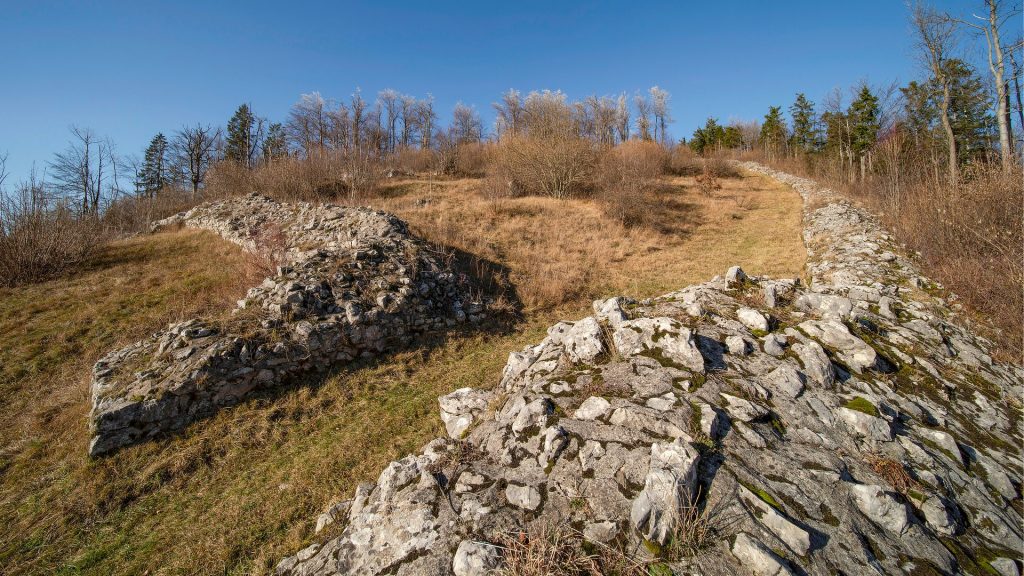
Around three million years ago the ground beneath the village of Grad was the site of the last volcanic eruption anywhere in present-day Slovenia. The crater it left is roughly a kilometer across, and Vulkanija stands on part of its floor. The low, rounded hills you drive through to reach the village are what that eruption shaped, so the landscape outside tells the same story the exhibits explain indoors.
2
Olivine is the mineral that put this village on the geological map
Olivine reached the surface inside the volcanic rock erupted at Grad, and it occurs here as nodules set in basalt tuff. In the abandoned quarry on the road towards Kuzma the host rock can still be seen in place. The museum gives the mineral a room of its own, including a screen on which you color olivine and watch added iron shift it from transparent through green to black. Oli, the park mascot, is a mole named after it.
3
A cartoon mole runs the whole tour
Every visit follows Oli, a mole presented as the resident expert on the underground and on Goričko's geology. He turns up in the films, on the screens and in the ride at the end, pursued throughout by a witch called Eza who wants the olivine crystals the eruption brought to the surface. The storyline gives younger visitors a thread to follow through a fairly technical subject, and it holds the hour together.
4
The visit is built as a descent and a return
You start at an interactive volcano table, put on VR goggles, walk through a recreated lava-tube set with falling-lava effects and handle real geodes. A lift then simulates a drop of 6,000 meters into a magma chamber. The return is a bumpy 3D train sequence with Oli, framed as the journey back to the surface. The guided section takes about an hour.
5
The geological museum was once a tannery
The museum occupies the Lednar tannery, an early twentieth-century building divided between a living quarter and a workshop. The concrete basins where hides were tanned and dyed have been preserved, and the last two rooms still explain leather-working with original tools and finished goods. Reusing the building means the geology exhibition and a piece of local craft history share one small site across five rooms.
6
More than 120 minerals fill the attic
Stairs lead from Oli's Kitchen up to the attic of the tannery, once the family's living space and, at its northern end, the loft where hides were dried. That whole floor is now given over to exhibitions and children's workshops. The mineral and crystal display is arranged as a teaching collection: ten cases present more than 120 minerals, each case carrying its own theme. A model of the Goričko volcano and the tools once used to win stone in the quarry stand alongside them.
7
Before the volcano there was a sea
The geological room reaches back beyond the eruption to the Pannonian Sea, displaying rocks that still carry the shells of its inhabitants. It also presents the large mammals that roamed the area roughly five million years ago, including mastodons and deinotheres, with a cast of a mastodon tooth on show. A drawn sequence explains the evolution of the proboscideans, of which only the Asian and African elephants survive today.
8
A kitchen where the rocks get cooked
The third room of the museum keeps the old tannery kitchen, complete with the wood-fired stove and its built-in oven preserved during the restoration. The room now explains the rock cycle: the four main rock types are set out on a circle, and at its center a film shows Oli and his kitchen assistant cheerfully cooking those rocks. Next door, an interactive sandpit lets you shape a volcano out of sand and then watch it erupt.
9
A road train runs out to the quarry and the crater rim
Between mid-March and mid-November the Oli road train leaves the Vulkanija car park for the basalt tuff quarry and returns along a panoramic route, weather permitting. The ride lasts 45 minutes and carries up to 54 passengers, with the final carriage adapted for wheelchair users. At the quarry a guide explains the volcanic rock and two short films cover quarry work and olivine. On the way you also get the legend of Kač, the dragon said to have lived in the volcanic rock beneath the castle.
10
A walking trail follows the rim of the old crater
Oli's Volcanic Trail leaves from Vulkanija, passes the village church and reaches the Kripta, the castle burial vault built on a second eruption point. It then continues past Slovenia's largest castle and follows the crater rim by an old orchard to the basalt tuff quarry and the Kačova mlaka pond before returning. The quarry lies about one kilometer from Vulkanija and is protected as a natural value of national importance. Walking out there makes the scale of the crater legible in a way the indoor exhibits cannot.
Visitor Wisdom
Traveler Insights
Combined public visitor ratings from Google and Tripadvisor. Last verified August 2026.
Guides who switch fluently between languages and adapt to the group in front of them. Effects convincing enough that adults admit to being caught out by them. A clear educational thread rather than a theme-park ride with no content. The mineral and crystal displays in the old tannery, which several visitors say they nearly skipped. The shop, particularly the local olivine and the polished stones.
Everything is indoors and the whole visit runs to about 90 minutes. Access to the park itself is by guided tour only, starting on the hour. A reservation is genuinely required, not merely advisable. The lava tube is a built set rather than a natural cave. The basalt tuff quarry is about a kilometer away and free to walk to; the road train that stops there with a guide is a separate seasonal extra.
Families with primary-school children get the most from the visit. Adults with an interest in geology find enough substance to hold them. School parties and organized groups, for whom the operator runs dedicated programs. Wet or very hot days, because the whole route is under cover. Less ideal for toddlers, and for visitors who want a genuine underground experience rather than a simulation. For that, Peca Underground takes you into a real mine by train.
Turning up unannounced when the operator requires a reserved time slot. Arriving after the last entry, which falls 90 minutes before closing. Coming on a Monday, when the park is closed all year round. Budgeting only an hour and then skipping the museum, which is the self-guided half of the ticket. Assuming the road train runs daily; for individuals it runs mainly in school holidays and at events.
Work through the tannery attic properly: ten cases and more than 120 minerals reward the extra ten minutes. Ask about the olivine nodules; the local mineral is the reason geologists know this village at all. If the road train is running, take it. The quarry is where you see the volcanic rock in place rather than in a case. Walk at least the first stretch of Oli's Volcanic Trail to see the crater from the outside. If you would rather hear it in German or English, say so when you book; the guides run tours in both.
The Oli storyline carries younger visitors through material that would otherwise be dry. Families repeatedly report that even restless children stay engaged for the full hour. Darkness, motion and a simulated eruption suit confident children from about five upward better than toddlers. The interactive sandpit and the rock-cooking kitchen give a second, hands-on layer after the guided part ends. The shop is a reliable end point, and small polished stones are the usual souvenir.
The guided route is deliberately dark; phones cope, but expect noise and keep compositions simple around the lit set pieces. The mineral cases in the tannery attic are the easiest subject in the building. Personal photography is allowed throughout the visitor areas, but the operator asks visitors not to photograph or publish images of staff and guides, and not to record the guided commentary or the films. Outside, the rounded volcanic hills of Goričko are the wider picture, best in low afternoon light.
The recurring note is surprise. Visitors expect a small municipal exhibition and find a carefully made, well-guided hour that explains a genuinely unusual piece of Slovenian geology. It is not large and it will not fill a day, but it is remembered warmly, particularly by families with children old enough to follow the story. Most people leave saying it justified the detour into this quiet north-eastern corner of the country.
Quick Facts
Estimated visit time
1–2 h
Best season
Spring, Summer, Autumn
Walking difficulty
Easy
Family friendly
Yes
Pet friendly
No

Entry Fee
Paid

Access type
Short paved walk
Help Improve This Listing
Found outdated information, a mistake, or a useful local tip? Let us know.
Suggest an Update →Help Improve This Listing
Your feedback helps us keep Explore In Slovenia accurate and useful for future visitors.
×Visitor Reviews
Write a review
No visitor reviews yet.
Be the first to share your experience.
No reviews yet!
Sorry! Please login first to submit reviews.